

News & Media
The Power of Family and Collaboration from BONEBAG authors David Elliott and E. M. Elliott
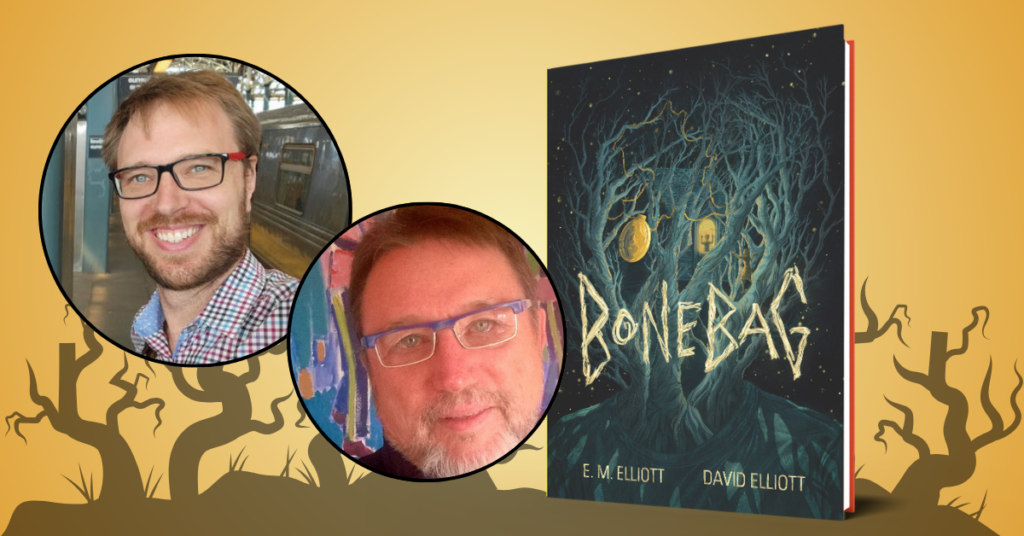
Learn about the process of writing as a father-son team in these short notes from David Elliott and E. M. Elliott, the authors of Bonebag (Astra Young Readers, 5/26/26), a riveting middle-grade fantasy that tells the story of a forest-dwelling boy forced to confront the mysteries of his life.
From David
The image came to me more than fifteen years ago: A boy living in a forest in a ramshackle cottage. His only companions? His strange and unloving parents. He has never seen another human being.
Without too much thought, I knew this was a loosely disguised analog of my own childhood. I also knew it was a starting point for a much larger story, one that went far beyond the details of my life. I understood, too, it was a story beyond my own ability to tell. If the narrative were to reach its potential, I needed a partner. I thought of my son.
From his earliest toddler years well into his adulthood, there are pictures of Eli, his chin tilted down, his concentration steady, his eyes focused on the book in his hand. But he was not only a reader. I knew he also had the chops to be a writer. Because of my own upbringing, I have few of the skills that typical American fathers pass on to their sons. I cannot throw a ball, or catch a fish, or build a doghouse. I have never held a golf club. But I did know a little about writing. This was my chance.
He said yes. That was the easy part. Neither of us knew really what we were getting into. I had never written with another person. I have a hard enough time controlling my own bad habits. We had a starting point, but that was all. No process. No roadmap. Only an unwavering trust in the other’s imagination, intuition, sensibilities, and good will. We began by alternating chapters, laying out together what we thought might happen next. That worked for a while. But about halfway through it devolved into a kind of organized chaos, made more chaotic still by our living in separate states.
You might think that two people writing one book would make the work go faster. Uh . . . no.
Still, word by word, the narrative grew. And grew. And grew. There is no GPS for writers. How could there be? They are navigating an unexplored landscape. So many wrong turns. So many dead ends. So many back-to-the-beginnings. But as lost as we sometimes were, we fought hard to keep our metaphorical fingers on our protagonist’s pulse, knowing, to borrow a trope from the great Vivian Gornick, that plot is only the situation. The real story is the character’s response to it. Miraculously, throughout the year and a half that it took us to come up with a finished draft, we had no disagreements. When I read the book now, I am still not sure who wrote what. Was that me? Or Eli? Perhaps that’s because I learned as much from my son as he might have learned from me. More even. More about writing. More about myself. More about him.
Writing with my son was a tremendous gift. The result of that gift is Bonebag, our gift to you. It is an adventure about family, friendship, connection, trust, and wonder. High adventures in themselves and the very foundations on which the book was written.
From E. M.
In a way, my dad and I had already been writing Bonebag together before he officially asked me to come aboard in late 2020. Whenever I visited my parents for a holiday or an escape from the stresses of city living, we would spend time bouncing ideas off each other until slowly, slowly, Bonebag’s amorphous form began to resemble the book you’re about to read.
Five years later, Bonebag is finally here.
Finding my way into Bonebag’s world wasn’t the easiest for me. Even after we’d written the outline, even after we’d started writing in earnest, I had to fight the discomfiting feeling that this was my dad’s book. He had had the idea long before we started talking about it, knew who the pro- and antagonists were and what they wanted, and even had a rough draft or two of the opening chapter. I recognized the themes—family and belonging and self-identity—as ones he’d explored in his other books and his experience as an author, in the early days of writing, left me with a fair amount of self-doubt regarding the quality of my own contributions.
I’m not sure exactly when I found my way in, when I began considering this our book, but I did. Eventually. It took some time, but I realized that, despite his years of experience, my dad was treating me as a full partner on this journey, listening to and accepting (or rejecting) my feedback as often as I was listening to and accepting (or rejecting) his. There is nothing so inspiring as trust, and his trust in me was unbreakable.
It didn’t hurt, of course, that we were largely in agreement on many of the major plot points and character arcs. I can’t remember a single major argument, although he did tell me once after I’d suggested a change during our second round of edits that I had too many ideas (true). The process—made even more difficult by the fact that we live hundreds of miles apart—would have been made even more arduous if we had not had that trust. The already copious number of emails, phone calls, and Zoom sessions would have increased. Chapters, which we took turns writing, would have been passed back and forth endlessly for edits or rewrites. But the trust allowed us to do what any good team knows how to do—communicate freely, without fear of judgment or ridicule (although I do seem to remember one or two really bad ideas—from both sides—that were, rightly, derided). We listened to each other, and we learned from listening. Bonebag is stronger for it. What more can you ask for from a co-author (or a father, for that matter)?
I hope Bonebag scares you. I hope it makes you laugh. I hope it makes you cry. But most of all, I hope it reminds you why reading is an inimitable pleasure. We put so much into making it what it is and are immensely proud of what the book became. Enjoy!
ABOUT THE BOOK
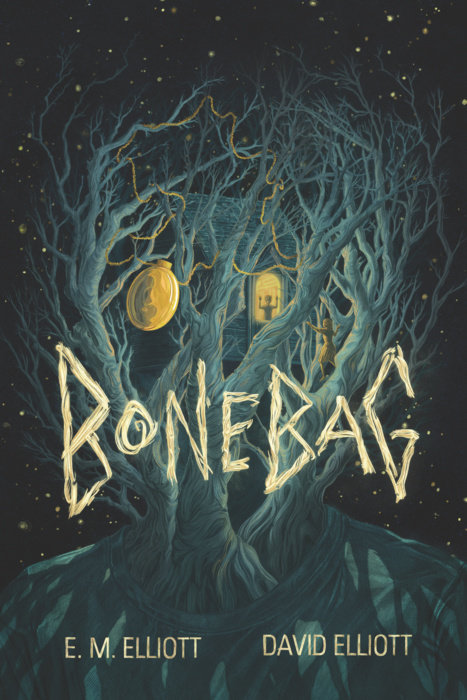
Trapped in a dark forest with his cold-hearted parents, Bonebag leads a cruel and isolated existence. However, he feels deep in his bones that things weren’t always this way: he has known happiness before. Why does it feel like it was in a past life?
From New York Times bestselling author David Elliott and his son, E.M. Elliott, this powerful middle-grade fantasy will take readers on a quest that tackles the mystery of belonging with high-octane twists and turns along the way.
★ “A dark, immersive tale that never loses its sense of hope… unforgettable.”—Booklist, starred review
★ “Genuinely scary, deliciously dark, and full of unexpected turns… Darkly thrilling; will keep readers turning pages until every riddle has been solved.”—Kirkus Reviews, starred review